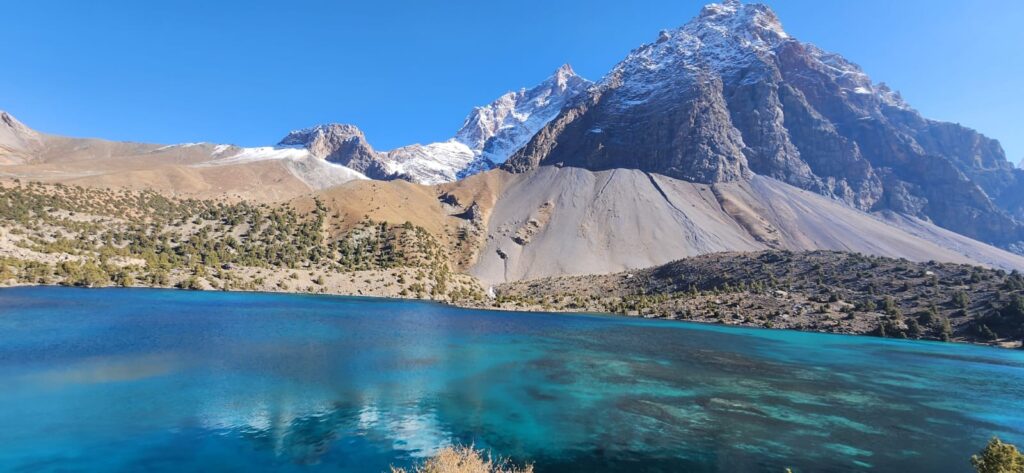
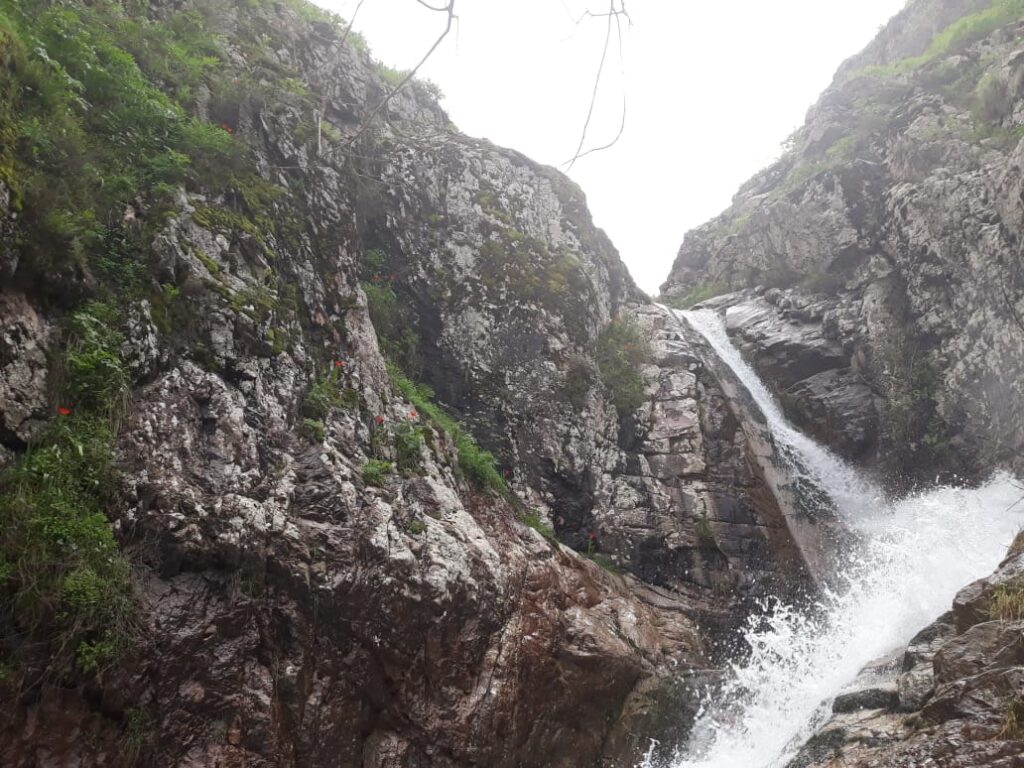
The water begins high in the glaciers, clear and frigid, tumbling through rock gorges until it flattens into the valleys. By the time it reaches the cotton fields of the Vakhsh or the orchards of the Zarafshan, the water is a different thing altogether: it is clouded, diverted, slowed by gates and channels built decades ago. In Tajikistan irrigation is not just infrastructure. It is memory, labor, and necessity, all bound to the soil.
The canals are everywhere once you look. Narrow earthen ditches trace through villages; concrete-lined channels from the Soviet era still run alongside highways. Some carry steady flows; others crumble, the concrete split and overgrown with weeds. “Most of our systems are over forty years old,” admits a Ministry of Water Resources report from 2015. “Rehabilitation is urgently needed, as more than 60 percent of canals suffer from deterioration” (World Bank, 2014).
In a small farm outside Qurghonteppa, an old man leans on his shovel, watching water seep from a cracked gate. He explains that the canal has not been fully repaired since the early 1980s. “We patch it ourselves,” he says, “but every spring the floods break something.” His voice carries no bitterness, just weariness. Irrigation is the difference between harvest and hunger. For cotton, for wheat, for vegetables, nothing grows without it.
The geography of irrigation is not only technical—it is cultural. Villages organize work around when the water comes. Families take turns, sometimes arguing in the night about who opened which gate too early. Children learn to swim not in rivers but in canals. To speak of Tajikistan’s irrigation is to speak of its society, where every drop of glacial meltwater is shared, contested, and carried by hand into fields.
The Soviet Union once prided itself on these vast systems. Engineers cut channels across deserts, raising the Amu Darya into canals that fed cotton monocultures. Tajikistan’s Vakhsh Valley became one of the empire’s breadbaskets of “white gold.” But what was triumph in Moscow was strain in the fields. By the late 1980s, salinization and waterlogging were widespread. Studies estimated that nearly 40 percent of irrigated land in Central Asia suffered reduced productivity due to poor drainage (FAO, 2012).
Today, the legacy is visible in its appearance. Canals are silting, pumps rust, and farmers improvise. A World Bank assessment warns: “Energy-inefficient pumping stations and deteriorating canals are leading to significant water losses—up to 50 percent in some systems” (World Bank, 2014). For a country where 70 percent of the population depends on agriculture, these losses are staggering.
Walking along an irrigation canal near Panjakent, one sees the ghosts of layered histories. Some channels date back centuries, first cut by hand with shovels and maintained by community mirabs, or water masters chosen by villages. Over them, Soviet engineers laid concrete and extended networks, imposing new hierarchies of control. After independence, funding collapsed, and the burden of maintenance returned to local hands. Farmers hire neighbors to dredge silt, or simply let canals shrink into trickles.
And yet, irrigation persists. Despite the decay, fields are still green. Tajikistan harvests nearly one million tons of cotton, most of it irrigated. Wheat production, encouraged by food security policies, relies on canals to double-crop fields once reserved for cotton alone. The paradox is that even broken systems still function, barely, in part because labor is abundant and cheap. Farmers and families fill the gaps with their own hands.
The contradictions are everywhere. In one district, canals overflow in spring floods, drowning crops. In another, pumps stand idle because villages cannot afford diesel fuel. The inequity is stark: upstream farmers sometimes take more than their share, leaving downstream fields dry. Disputes rise quickly, sometimes mediated by village elders, sometimes escalating into bitter rivalries. A 2016 report from the International Water Management Institute describes how “conflicts over irrigation timing are among the most frequent disputes in rural communities” (IWMI, 2016).
There is also the issue of scale. Tajikistan contributes the majority of Central Asia’s water through its rivers, but controls little of how it is used downstream. In the 2010s, Uzbekistan complains that Tajikistan’s hydropower projects reduce flow for irrigation; Tajikistan responds that its own farmers struggle with failing canals. The politics of irrigation extend far beyond fields, they are woven into regional geopolitics.
Meanwhile, climate change sharpens the stakes. Glaciers are shrinking, snowpacks are less predictable, and the timing of runoff is shifting. Farmers already notice water arriving earlier in spring, leaving shortages by late summer. “We cannot rely on the calendar anymore,” says a farmer in Gissar, quoted in a UNDP field survey. “The water comes when it wants.”
International donors see irrigation as both problem and solution. Projects proliferate: lining canals with concrete, installing new pumps, introducing water-user associations to replace Soviet-style collectives. Some succeed, others falter once funding ends. The challenge is not only technical but institutional: who controls the gates, who pays for fuel, who resolves disputes.
Yet despite these challenges, there is resilience. In 2016, across Tajikistan, villages organize canal-cleaning days each spring. Children run ahead with buckets, clearing weeds. Women cook food for the workers. The rhythm continues, as it has for centuries, because without water, life here is impossible.
The irrigation systems of Tajikistan are decaying, yes. But they are also enduring, patched by hands and hope, carrying glacier melt into the valleys where people live and plant. To stand by a canal is to see both decline and persistence: cracked gates, but flowing water; rusted pumps, but green fields. It is to see a geography of survival, where every drop tells a story of mountains, politics, and people who refuse to let their land go dry.
References
- FAO. (2012). Irrigation in Central Asia in Figures. AQUASTAT Survey. Rome: Food and Agriculture Organization.
- IWMI. (2016). Water User Associations and Irrigation Conflicts in Central Asia. International Water Management Institute, Report No. 162.
- UNDP. (2016). Voices from the Field: Climate and Water in Tajikistan. Dushanbe: UNDP Tajikistan.
- World Bank. (2014). Tajikistan Agricultural Sector Review: Irrigation and Water Resources. Washington, DC: World Bank.