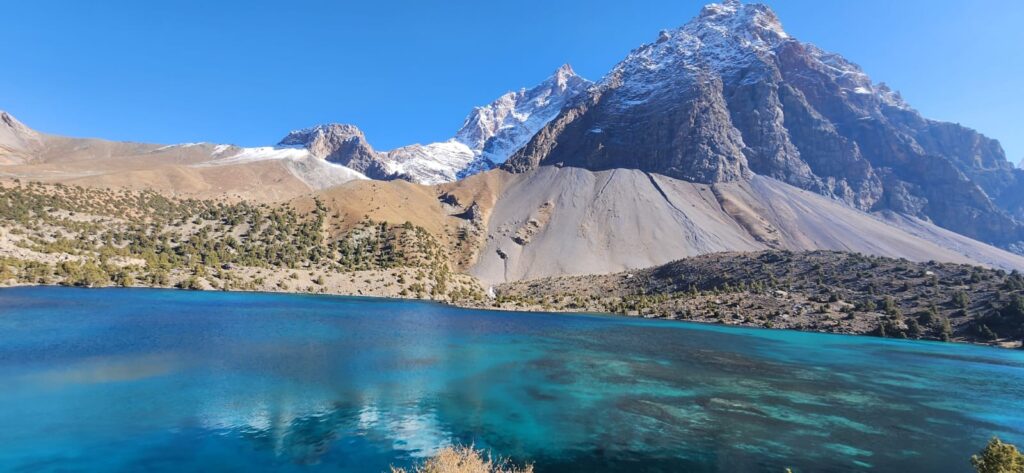
The high Pamirs open in wide silence. Valleys stretch upward toward passes, where wind carries dust and snow. Paths cut into slopes, barely visible from a distance, mark the movement of herds and families. These pastoral routes are not only trails of animals and people but geographies of mobility, tradition, and survival. To follow them is to walk into a seasonal cycle, where summer and winter are inscribed in land.
In spring, when snow begins to loosen on lower slopes, herders lead flocks from village corrals to higher grazing grounds. Goats, sheep, and yaks press forward in uneven lines, bells clanging against morning air. Families pack belongings onto donkeys or trucks if roads allow. Summer is the season of ascent. For months, tents and stone huts dot alpine pastures. Grasses are short but abundant, nourished by meltwater and thin soils. At night, fires burn with dried dung. Stories pass in the dim light, echoing older generations who walked the same trails.
A herder near Murghab says, “We go where the animals can eat. My father went here. His father too. The mountain tells us when to move.” His words frame geography as instruction, mobility as inheritance. These movements are more than pragmatic; they are rhythms of belonging.
Pastoral routes are lines across space and time. They are paths cut not just by hooves but by memory, kinship, and obligation. They embody a geography that resists stasis, reminding us that mobility itself is a way of inhabiting land. To trace them is to trace the continuity of culture in landscapes of change.
Mobility in the Pamirs has long been shaped by ecology. Harsh winters make year-round grazing in high valleys impossible. Summer meadows, called jailoo, provide rich fodder for a few months. Winter requires descent to valleys, sheltered spots near rivers or villages where hay and stored fodder can supplement sparse grazing. This cycle ties families to multiple places. Homes are plural: a village house, a summer hut, sometimes even a temporary shelter in transit.
During the Soviet period, collective farms sought to reorganize mobility. Herders were placed under kolkhoz and sovkhoz structures, routes formalized, livestock numbers regulated. Trucks ferried animals to planned pastures. Some traditional routes were disrupted, replaced by engineered grazing rotations (Herbers, 2001). Yet even within collectivization, local knowledge persisted: where snow lingers longest, where water runs, where wolves prowl. After independence, with collective farms dissolved, many families reclaimed patterns closer to older practice, though now constrained by borders, markets, and state regulations.
The Pamir Highway reveals some of this tension. Asphalt crosses valleys that herders once moved through freely. Now mobility bends around road infrastructure, police checkpoints, and new village boundaries. The state issues grazing permits; access to distant pastures requires negotiation. In borderlands near Kyrgyzstan and Afghanistan, routes are sometimes truncated, limited by fences or political agreements. Yet herders adapt: a family might graze fewer animals or shorten seasonal migration. Geography of movement is redrawn, but movement persists.
Ecologists see in these patterns a form of sustainable land use. Rotational grazing spreads pressure across zones, allowing pastures to regenerate. Without mobility, overgrazing near villages would strip grass and soil. Studies of high-altitude ecosystems in Central Asia note that nomadic and semi-nomadic routes historically maintained ecological balance (Kreutzmann, 2013). But with restrictions and sedentarization, pressure has increased on accessible areas, while remote pastures grow underused. Mobility, paradoxically, is both environmental protection and social practice.
Women’s voices complicate the story. In some households, men drive herds, while women manage village homes. But in many pastoral families, women accompany seasonal moves, tending livestock, weaving, milking, and processing dairy. Cheese and yogurt are stored for winter. “The pasture is our summer home,” one woman says, standing beside a felt tent. “We work harder here, but the children are strong, the animals fat.” Her tone suggests both burden and pride.
Geopolitics overlays this pastoral geography. Routes cross invisible lines of the Gorno-Badakhshan Autonomous Region (GBAO), districts with distinct regulations. In some places, military presence constrains free passage. Cross-border grazing that once linked Kyrgyz and Tajik herders now confronts fences and disputes. Local elders remember when valleys near Karakul were open to both communities, when summer pastures were shared. Now grazing rights are policed, sometimes leading to clashes. Geography that once united now divides.
Markets also transform routes. Demand for cash pushes herders to adjust cycles, bringing animals to markets in Murghab or Khorog at particular times. Some shorten pasture stays to reach sales. Others migrate less, focusing on fodder production near villages. Mobile pastoralism bends toward economic geography: routes that once followed grass now follow prices.
Yet pastoral routes remain etched in land. Satellite imagery shows faint lines across slopes, visible even when unused for years. Archaeologists trace ancient caravan trails overlapping with modern herding paths (Kaniuth, 2013). Movement is continuity, connecting Silk Road trade to contemporary grazing. Some routes double as pilgrimage paths to shrines, linking sacred geography with subsistence.
Risk is constant. Snowstorms can trap herds in high valleys. Drought can dry meadows. Wolves and snow leopards stalk edges. A herder recounts losing twenty sheep in one night, taken by predators. “The mountain takes as it gives,” he shrugs. This precariousness is accepted, part of life entwined with risk.
Climate change presses uncertainty into these cycles. Glaciers retreat, altering water supply to meadows. Snow arrives later, melts earlier, shortening or shifting the pasture season. Studies show vegetation zones moving upward, forcing adaptation (Lioubimtseva & Henebry, 2009). Herders adjust in leaving later in spring and returning earlier in autumn. But some valleys may become untenable in future, pressuring households toward sedentarization or out-migration.
In this shifting terrain, pastoral routes remain powerful cultural anchors. Songs and stories speak of valleys by name, herds by number, ancestors by movement. Children learn geography by walking it: crossing passes, watching stars and memorizing water sources. Education is tactile, spatial. A boy says, “I know the mountain because I walked it with my father.” That walking is curriculum.
In Dushanbe, planners and policymakers debate mobility in abstract terms- pasture management, rangeland carrying capacity, livestock productivity. But in the Pamirs, mobility is lived daily. It is choices about when to move, how many animals to bring, which valley to trust. These decisions are made under pressure from weather, predators, markets, and state policy. The routes remain, yet each year they are reinterpreted.
Even in decline, mobility persists as idea. Families forced to settle still remember routes, tell stories of past moves. The geography lives in memory, shaping identity. Routes are not only physical lines but cultural maps, ways of thinking about land. A man who no longer herds says, “When I dream, I dream of pasture.”
To think of pastoral routes is to think of a geography in motion. It resists fixity, reminding us that settlement is not the only form of belonging. Mobility itself is habitation. Pastoralism teaches that geography is not just where we stay but how we move, and that movement carries memory, ecology, and culture in every step.
References
- Herbers, H. (2001). Transformation of nomadic pastoralism in the Eastern Pamirs of Tajikistan. Central Asian Survey, 20(3), 319–336.
- Kaniuth, K. (2013). Caravan routes and archaeological traces in the eastern Pamirs. Journal of Asian Archaeology, 22, 155–170.
- Kreutzmann, H. (2013). Pastoral practices in High Asia: Agency of ‘development’ effected by modernisation, resettlement and transformation. Pastoralism: Research, Policy and Practice, 3(4).
- Lioubimtseva, E., & Henebry, G. M. (2009). Climate and environmental change in arid Central Asia: Impacts, vulnerability, and adaptations. Journal of Arid Environments, 73, 963–977.