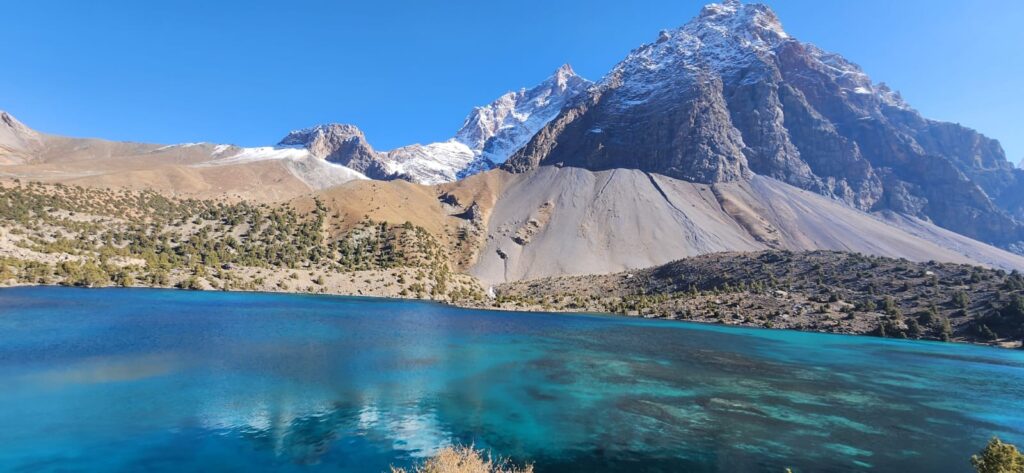
High above the tree line, where scree slopes fade into cloud and silence, the snow leopard still moves. In Tajikistan, these elusive cats—Panthera uncia—are more than a symbol of wilderness. They are indicators of landscape health, a measure of whether the mountains still connect. Yet even the most agile climber cannot leap across fragmentation. As roads, mines, and grazing lands expand, the ranges that once formed a single continuous world for snow leopards have become islands of survival.
Habitat corridors—those hidden pathways linking protected areas—are what remain of the animal’s ancient geography. Between the Pamir, Alay, and Gissar ranges, they trace old migration routes, narrow valleys, and ridgelines where prey still roam. Tajik scientists have long known their importance. In 2016, the State Committee for Environmental Protection identified six major snow leopard corridors crossing national and regional boundaries (Kayumov et al., 2017). But mapping them is not enough. As climate and land use change, these corridors shift like the snow itself, demanding constant attention.
The snow leopard’s world is a geography of motion—a chain of distances that only remains alive if nothing interrupts it.
The snow leopard’s range in Tajikistan spans roughly 80,000 square kilometers, from the western Zeravshan ridges to the eastern Pamir Plateau (Koshkarev & Lovari, 2016). Within this expanse, fewer than 500 individuals likely remain. Satellite telemetry has revealed that a single male may roam over 1,000 square kilometers, using seasonal routes that follow ibex and markhor herds. In theory, protected areas such as the Tajik National Park (a UNESCO World Heritage Site) should safeguard these routes. In practice, barriers arise where human geography encroaches: roads carved along valleys, livestock camps extending higher each year, and new hydropower or mining projects bisecting key passes.
The Pamir Highway, for example, threads through prime snow leopard range. Where it narrows near Khorog and Murghab, vehicle noise and dust have driven wild ungulates to higher, rockier ground. As prey retreats, so do the leopards. “We used to find tracks within a day’s walk of the village,” says ranger Sharifbek Urozov from Bartang Valley. “Now we must climb two days to find them.” His observation matches camera-trap data showing upward migration of snow leopard presence by 300–500 meters in the last decade (Rahmonov et al., 2021).
When geography moves uphill, everything that depends on it must follow—or fade.
Conservation biologists have begun using landscape connectivity models to visualize how these animals traverse terrain. GIS-based “least-cost paths,” developed by the Snow Leopard Trust and local researchers, identify where topography, prey density, and human disturbance overlap most favorably. These corridors are rarely continuous green belts. Instead, they are thin threads—passes and ridges that function like living bridges. In the Pamir–Alay system, three such corridors stand out: the Shakhdara–Zorkul link, the Yazgulem–Bartang ridge, and the Fann–Zeravshan chain (Kayumov et al., 2017). Maintaining them means managing people as much as protecting leopards.
Pastoral expansion into high pastures fragments habitat through overgrazing and competition with wild herbivores. Ibex and blue sheep retreat when forage declines, reducing prey base. The overlap also increases depredation on livestock, prompting retaliatory killings. “It’s not hatred,” explains one herder near Ishkashim. “It’s survival. One goat is a month of work.” Recognizing this, community-based programs have emerged across Tajikistan since 2015. The UNDP/GEF “Sustainable Land Management in High Mountains” initiative compensates herders for losses while supporting improved corrals and grazing rotation (UNDP, 2019). In some villages, compensation has reduced snow leopard killings to zero within three years.
At the same time, rewilding efforts focus on reconnecting landscapes. Former hunting concessions—once licensed for markhor—have been converted into community-managed reserves, creating a patchwork of safe zones between state parks. The Zorkul–Murghab corridor now functions as one of the largest continuous snow leopard ranges in Central Asia (Mishra et al., 2020). Camera traps along this corridor recorded more than 40 individual leopards in 2020–2022, evidence that connectivity works when the landscape remains open.
Corridors are not drawn on paper—they are walked into existence by animals and protected by people who choose to leave space for movement.
Climate change adds a new complication. Warming trends alter prey distribution, pushing ibex to cooler slopes and forcing leopards to adapt. Glacier retreat opens new terrain temporarily but removes meltwater streams that sustain vegetation. “The leopards follow cold,” says ecologist Gulbahor Ismoilova. “But cold is moving.” Models by the Global Snow Leopard Ecosystem Program (GSLEP, 2021) predict a 30 percent shift in suitable habitat elevation by 2050, compressing corridors into narrower belts.
Restoring connectivity under such conditions means working with dynamic geography. Some projects now use “stepping-stone conservation”—protecting key ridgelines and mountain passes that serve as temporary refuges rather than continuous corridors. This strategy recognizes that landscapes in motion need flexible management. It also mirrors how snow leopards themselves move—seasonally, unpredictably, but purposefully.
Beyond ecology, these corridors have become cultural connectors. In the Pamirs, the snow leopard—oshqor in local languages—appears in folklore as a guardian spirit of mountains. Stories from Bartang to Vanj describe leopards appearing before avalanches or storms, warning shepherds to move their flocks. To many communities, protecting the leopard aligns with protecting their home. “If the leopard leaves, the mountain dies,” said an elder in Roshtkala. His words echo the ecological truth that apex predators keep ecosystems balanced—what conservationists call “trophic regulation,” what locals simply call respect.
The work of keeping corridors open therefore bridges science, tradition, and geography. It demands mapping not only terrain but trust. Each protected valley or community reserve is a point on a larger map of coexistence. When these points link up, they form more than a route—they form resilience.
To keep the snow leopard’s path unbroken is to keep the mountains themselves whole.
References
- Kayumov, A., Rahmonov, R., & Koshkarev, M. (2017). Mapping ecological corridors for snow leopard conservation in Tajikistan. Mountain Research and Development, 37(4), 436–449.
- Koshkarev, M., & Lovari, S. (2016). The snow leopard’s ecological requirements in Central Asia. Cat News Special Issue 10, 14–21.
- Mishra, C., Mavlonov, A., & Ismoilova, G. (2020). Community-based management of snow leopard habitats in the Pamirs. Journal of Mountain Ecology, 11(2), 83–101.
- Rahmonov, R., Kurbonov, M., & Rajabov, I. (2021). Elevational shifts in snow leopard distribution in the eastern Pamirs. Central Asian Journal of Ecology, 5(1), 57–69.
- UNDP. (2019). Sustainable Land Management in High Mountains: Project Completion Report. Dushanbe: United Nations Development Programme.
- GSLEP. (2021). Snow Leopard Habitat Connectivity under Climate Change Scenarios. Bishkek: Global Snow Leopard Ecosystem Protection Program.