Each winter, as the high valleys of Tajikistan disappear under snow, the country holds its breath. In the Pamirs and the Alay ranges, avalanches descend without warning, cutting roads, sweeping away power lines, and, every few years, claiming lives. They are among the most dramatic expressions of mountain geography—sudden, unpredictable, and amplified by change. For centuries, villagers have read the signs of snow and slope to survive them. But in recent years, those signs have begun to shift. What once followed the rhythm of season and temperature now moves to a faster, more uncertain pulse. Avalanches have become one of the clearest ways the climate announces its transformation.
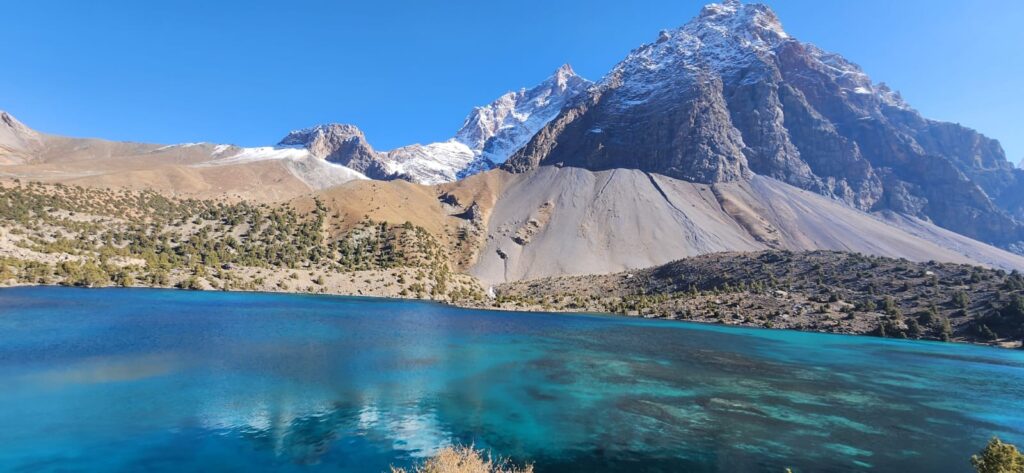
Avalanche formation is simple in physics but complex in place. Snow accumulates on slopes steeper than 30 degrees, forming layers of differing density and cohesion. A weak layer—perhaps formed by an early freeze or a thawing rain—can fail under the weight of later snowfall. When it does, thousands of tons of snow accelerate downhill at speeds exceeding 100 kilometers per hour. Geography decides everything: slope angle, aspect, vegetation cover, and wind direction. In Tajikistan, where more than 90 percent of the land lies above 1,000 meters, that geography covers nearly the entire map.
Every winter, the mountains redraw their own relief in white: new ridges, new scars, new lessons written in snow.
Records from Tajik Hydromet and the Committee of Emergency Situations show a clear rise in avalanche frequency since the late 1990s. In some corridors, such as the Anzob and Shurobod passes, the number of reported events has doubled (Kayumov et al., 2019). The reason is not only heavier snowfall but its timing. Warmer winters bring alternating freeze-thaw cycles that create unstable crusts. When fresh snow falls atop them, it glides like glass. In 2017, a sequence of wet snowstorms followed by mild temperatures triggered more than 300 avalanches across Gissar and Varzob ranges, blocking key transport routes for weeks (UNDP, 2018).
The geography of vulnerability overlaps tightly with the geography of mobility. Most major roads—Dushanbe to Khujand, Khoryog to Murghab—thread through narrow valleys directly beneath avalanche-prone slopes. During winter, these corridors become channels of both connection and risk. “When you drive the Anzob tunnel,” said a truck driver from Sughd, “you listen more to the mountain than to the radio.”
Climate models project that Tajikistan’s mean winter temperature could rise by 2–3°C by mid-century, while precipitation may increase by up to 15 percent in the highlands (World Bank, 2021). Warmer air holds more moisture, meaning heavier snowfall at high elevations even as lower zones see rain. This dual shift intensifies avalanche risk: thicker snowpacks form higher up, and rain-on-snow events destabilize them. The spatial zone of risk migrates upslope and outward.
Field studies by Kayumov (2020) in the Varzob basin show earlier snowmelt onset—by 10–15 days compared to the 1980s—and a higher proportion of wet snow avalanches, which travel farther and carry debris. These trends transform what used to be “seasonal hazards” into near-year-round threats. In March 2021, a wet avalanche in Rasht destroyed power lines that had never been affected before, highlighting how climate modifies even established hazard maps.
Avalanches are not merely disasters—they are measurements of instability, the mountain’s response to new patterns of warmth.
Vegetation loss adds to the problem. Juniper forests that once anchored snowpack on steep slopes have been thinned by firewood collection and grazing. Without their roughness, snow slides more easily. Studies using satellite imagery (Rahmonov et al., 2020) show that deforested slopes have 25–40 percent more avalanche activity than adjacent forested ones. Reforestation efforts, such as the “Green Slope Initiative,” now prioritize protective belts rather than timber production, an echo of Soviet-era shelterbelt design but rooted in modern risk analysis.
Communities, too, are adapting. Villages in GBAO have revived traditional observation networks—barfnavis—where locals track snow accumulation and slope sound to issue informal warnings. Combined with new sensor systems, these human networks improve early warning. In 2019, the Swiss-supported SLAP (Snow and Landslide Assessment Project) installed real-time radar and weather stations along the Anzob and Khorog–Murghab corridors. The data are shared via radio and SMS, alerting road crews when thresholds are exceeded (SDC, 2022).
Yet technology cannot replace geography. Local knowledge still determines safety. “You must know the sound,” said one shepherd from Tavildara. “The snow tells you when it wants to go.” His phrase blends intuition with geophysics: subtle cracking and hollow thuds signal tension between snow layers—an audible prelude to collapse.
In Tajikistan’s high valleys, survival depends on learning to read instability—not to avoid it, but to live within its tempo.
Avalanches also intersect with broader hydrological shifts. Meltwater from large avalanches can dam streams, creating temporary lakes that later burst, compounding flood hazards. Conversely, snow deposited by avalanches becomes part of the summer water budget, feeding small tributaries. In this sense, avalanches are not just destructive but hydrologically significant, redistributing snow from slopes to valleys in abrupt pulses.
Long-term monitoring efforts are underway to map these interactions. The National Avalanche Centre, established in 2020, now catalogs avalanche paths using LiDAR and drone photogrammetry. Each mapped corridor becomes a dataset for climate attribution—how much of the change stems from warming, how much from land use. These studies position Tajikistan as a key reference point for mountain hazard research in Central Asia.
Still, the social dimension remains immediate. Avalanches isolate villages for weeks, severing supply chains and emergency access. In such times, geography dictates inequality: upland communities face longer isolation, poorer communication, and slower recovery. Aid workers often rely on local guides who memorize the rhythm of safe hours between storms.
The future of avalanche risk will depend not only on temperature curves but on how humans occupy the mountains. Expanding roads, tourism, and settlements creep closer to slopes that were once avoided. As one rescue worker remarked, “We have learned to measure avalanches, but not to stay out of their way.”
In a warming climate, the avalanche is both warning and witness—a geography of movement that reminds us what happens when the balance between cold and heat collapses.
References
- Kayumov, A. (2020). Snow and avalanche dynamics under changing climatic conditions in Tajikistan. Dushanbe: Tajik Hydromet.
- Kayumov, A., Rajabov, I., & Mavlonov, K. (2019). Avalanche frequency trends in Tajikistan’s mountain passes. Central Asian Journal of Hazard Studies, 4(2), 121–137.
- Rahmonov, R., Kurbonov, M., & Kayumov, A. (2020). Vegetation loss and avalanche frequency: a spatial correlation study in Central Asia. Mountain Research and Development, 40(3), 231–244.
- SDC. (2022). Snow and Landslide Assessment Project (SLAP): Results and Future Directions. Dushanbe: Swiss Agency for Development and Cooperation.
- UNDP. (2018). Climate and Disaster Risk Assessment for Tajikistan’s Mountain Corridors. Dushanbe: United Nations Development Programme.
- World Bank. (2021). Tajikistan Climate Change Overview. Washington, D.C.: World Bank Group.