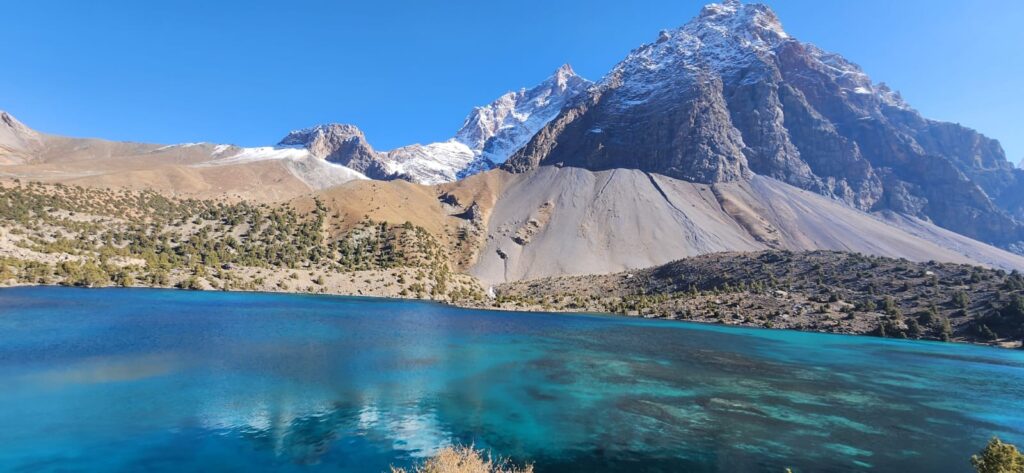
The Pamir Mountains form one of Central Asia’s most remarkable tectono-magmatic provinces, bridging the Himalayan and Tien Shan systems. The area records over 100 million years of crustal construction, destruction, and reworking related to the northward advance of the Indian plate and the closure of the Neo-Tethys Ocean. Among its defining geological signatures are extensive Late Cretaceous–Paleogene magmatic belts and a rich endowment of metallic mineral deposits.
During the Late Mesozoic, southern Tajikistan occupied a transitional zone between the passive continental margin of Eurasia and the approaching Tethyan subduction system. Subduction-related magmatism initiated in the Late Cretaceous as oceanic lithosphere descended beneath the active continental edge. This process generated voluminous calc-alkaline intrusive and volcanic complexes, many of which now compose the basement of the South Pamir terrane.
By the Paleogene, collision between island arcs and continental fragments intensified crustal thickening, producing extensive granitic batholiths and volcanic suites. These rocks, ranging from andesitic to rhyolitic compositions, record progressive crustal melting and assimilation processes typical of collisional orogens.
Petrochemical and isotopic analyses summarized by Li et al. (2023) show that the Pamir magmatic rocks carry signatures of both mantle-derived and crustal components. Trace-element enrichments in large-ion lithophile elements (LILEs) and depletions in high-field-strength elements (HFSEs) indicate a subduction-modified mantle source. Subsequent crustal anatexis and magma mixing generated metal-rich fluids, responsible for extensive porphyry-type and skarn mineralization.
Field mapping and geochronology link these mineral systems to Paleogene intrusions dated between 55 and 35 Ma. Major deposits include Cu–Au–Mo porphyries and Pb–Zn–Ag skarns aligned along northeast-trending structures that parallel the regional magmatic arcs.
The spatial coincidence of magmatic belts and metallogenic zones in the Pamir underscores how post-subduction magmatism became the primary engine for Tajikistan’s metallic wealth.
Magmatic emplacement and mineralization were strongly influenced by crustal faults inherited from earlier tectonic phases. Reactivation of deep structures during the Indo-Eurasian collision facilitated magma ascent and hydrothermal fluid migration. In particular, the Trans-Pamir fault system acted as a major conduit linking mantle melts to shallow crustal levels.
Recent geophysical data suggest partial melting persists at depth, implying that magmatic and geothermal activity could still be ongoing. This dynamic setting contributes to elevated regional heat flow and hydrothermal alteration zones observed in satellite imagery.
Across Tajikistan, metallogenic provinces align with magmatic arcs of different ages: the southern Pamir belt (Cu–Au–Mo), the central Pamir belt (Pb–Zn–Ag), and the northern marginal belt (Fe–Mn). These provinces mirror those of adjacent Afghanistan and western China, highlighting a trans-boundary metallogenic system tied to the same convergent geodynamics.
The Pamir orogen provides a natural laboratory where continental collision, magmatism, and mineralization can be studied as a single, integrated process—linking tectonic evolution directly to resource formation.
Future exploration and geoscientific research in Tajikistan should prioritize high-resolution geochronology, isotope tracing, and geophysical imaging to constrain magma sources and metal transport mechanisms. Understanding these links will refine models for ore-forming systems and guide sustainable mineral resource management within the Pamir region.
References
- Li, J., Wang, Z., Chen, Y., et al. (2023). Petrogenesis and metallogenic significance of Late Cretaceous–Paleogene magmatism in the Pamir area, Tajikistan. Frontiers in Earth Science, 11, 1289000. https://doi.org/10.3389/feart.2023.1289000
- Shoymuratov, A., et al. (2024). Geological aspect and oil and gas potential of the Mesozoic and Cenozoic units of the Tajik Depression (SW Tajikistan). IJESKA, 6(1), 446.
- Burtman, V. S., & Molnar, P. (1993). Geologic and geophysical evidence for deep subduction of continental crust beneath the Pamir. GSA Special Paper 281, 1–76.