High above the valleys, the mountains gleam white, their glaciers stretching across ridges like frozen rivers. From afar they seem eternal, a steady crown of ice feeding the rivers below. Up close, they are moving, groaning, shrinking. In Tajikistan’s Pamirs and Alay ranges, glaciers cover thousands of square kilometers, storing the water that sustains life downstream. But their mass is retreating year by year, and the change is visible to anyone who climbs high enough to see.
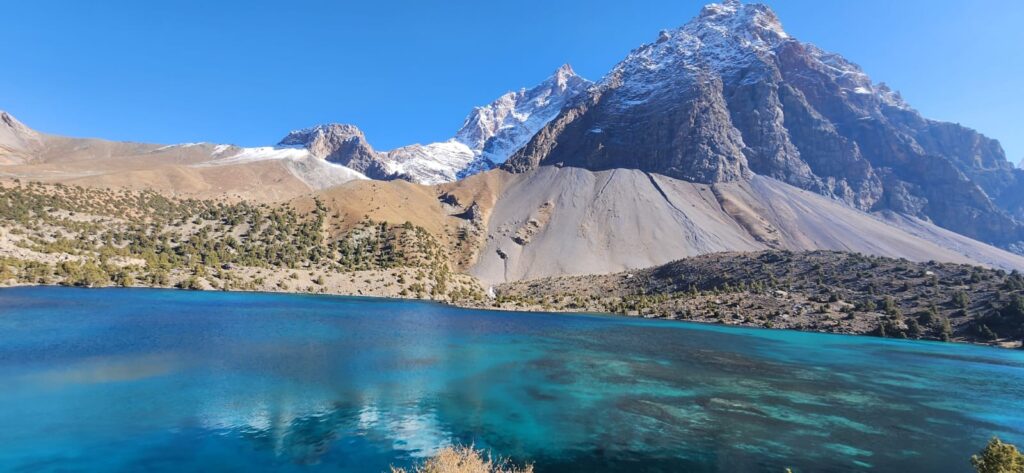
Climbers who return after only a decade describe moraines where once there was ice, lakes forming in depressions left behind, and meltwater streams running earlier in spring. Scientists record the same story with precision. According to the Academy of Sciences, more than a third of Tajikistan’s glacier volume has disappeared since the mid-twentieth century (Stokes et al., 2011). Remote sensing images confirm what shepherds already say: “The snow is thinner. The ice has pulled back.”
For the valleys below, this is no distant phenomenon. Rivers run fuller in spring but falter in late summer, throwing irrigation schedules into disarray. Hydropower plants spin turbines harder during floods, then stand underused during drought. Farmers shift planting patterns, but uncertainty reigns. A United Nations report notes that glacial retreat is “one of the most pressing climate-related risks for Central Asia” (UNDP, 2014). The mountains are melting, and with them, predictability itself.
Glaciers are often imagined as silent, immovable giants. Here they feel alive- breathing, shrinking, bleeding into rivers. Their retreat is not abstract but embodied in the flash floods that sweep roads, the empty canals in August, the shifting lakes that threaten to burst. To live beneath these glaciers is to live with their moods, their rhythms, their fragility.
Communities adapt as best they can. Villagers in Gorno-Badakhshan monitor new glacial lakes, fearing sudden outburst floods. Authorities place early-warning sensors near vulnerable basins, though coverage is sparse. NGOs teach schoolchildren about climate change with drawings of mountains losing their caps of white. Awareness grows, but solutions remain partial. You cannot replant a glacier.
Still, resilience appears in the smallest details. Farmers experiment with drought-resistant crops; hydrologists test methods for storing excess spring water in reservoirs. Elders recall when snow once lingered until June, using memory as a guide to change. Their stories mix nostalgia with pragmatism: “We cannot stop the melting, but we must learn to live with it.”
Standing on a ridge near Fedchenko Glacier, one of the largest in Eurasia, the air is sharp and thin. Below, ice stretches in fractured lines, gray with dust, edged by pools of meltwater. It is immense and yet clearly vulnerable. From here, the connection is stark: the fate of cities, farms, and families far below depends on the endurance of these frozen heights.
References
- Stokes, C. R., Gurney, S. D., Shahgedanova, M., & Popovnin, V. (2011). Late-20th-century changes in glacier extent in the central Pamir Mountains. Global and Planetary Change, 75(3–4), 172–185.
- UNDP. (2014). Climate Risk Management in Central Asia: Regional Assessment. Dushanbe: United Nations Development Programme.
- World Bank. (2015). Turn Down the Heat: Confronting the New Climate Normal. Washington, DC: World Bank.